




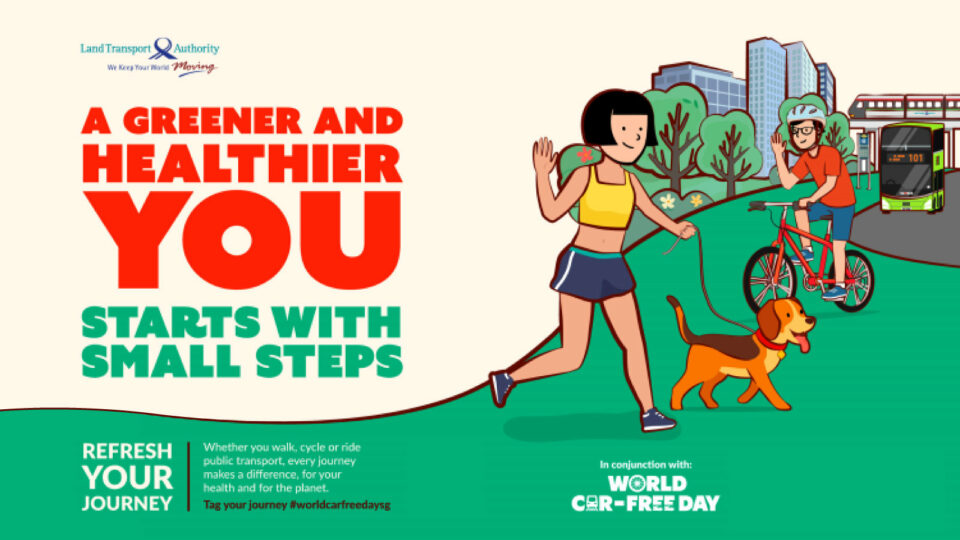

Singapore is increasingly embracing car-lite living. Two flagship ideas are Car-Free Zones and World Car-Free Day.
- Car-Free Zones are specific streets and precincts that are regularly closed (partially or fully) to vehicular traffic during certain hours. The Urban Redevelopment Authority (URA)’s Go Car-Lite initiative lists zones like Bali Lane & Haji Lane, Baghdad & Bussorah Streets, and Liang Seah Street. These zones restrict vehicles during afternoon and evening periods, weekends, public holidays, etc.
- World Car-Free Day, observed on 22 September each year, is an annual event promoted by Singapore’s Land Transport Authority (LTA). On this day, car usage is reduced in selected areas, and people are encouraged to embrace walking, cycling, and public transport. For 2025, the event will be marked with special activations and promotions throughout September to further promote a car-lite lifestyle.
These initiatives are about more than just regulation; they create opportunity. Space opens up for public performances, pop-ups, communal art, street food stalls, community bonding, and physical activity. For runners, fitness groups, cyclists, families — car-free zones offer a different kind of urban playground.
Table of Contents
Where & When Car-Free Zones Are in Singapore
Here are some recurring car-free zones you might explore:
| Zone | Days / Hours Vehicular Access Closed |
|---|---|
| Bali Lane & Haji Lane | Mon-Fri: 3pm-1am ‹ weekends & eve of PHs: 12noon-1am |
| Baghdad Street & Bussorah Street | Fri: 3pm-1am; Sat, Sun, Eve of PH: 12noon-1am |
| Liang Seah Street | Fri, Sat, Sun & Public Holiday: 6.30pm-12am |
These hours are ideal for evening strolls, casual meals, nightlife, and events. On official car-free days, related roads may be closed or partially closed, depending on the location and organiser.
Opportunities for Sport and movement
The Land Transport Authority (LTA) notes that World Car‑Free Day encourages a car‑lite lifestyle by showcasing the benefits of walking and cycling in a safer environment. Its “Refresh Your Journey” campaign provides an interactive map with scenic bus routes and suggested cycling routes and encourages participants to discover events while walking, cycling or using public transport.
A good example is the Architecture in Motion tour (21 Sep 2025), where participants explore Punggol Green’s linear park and are urged to walk, cycle or hop on public transport. Similarly, the HDB Punggol Northshore Sustainability Trail (28 Sep 2025) invites residents to join a guided trail and encourages walking, cycling or taking public transport to stay active.
These events show that car‑free initiatives are not just about traffic control but about opening streets for leisurely jogs, family walks, cycling tours and even pop‑up fitness classes.
Community Fitness Events
On Car‑Free Day itself (22 Sep 2025), ActiveSG is organising a Hike, Walk & Picnic from Sengkang Sports Centre to Bishan–Ang Mo Kio Park (8 am–1 pm). Participants are invited to “step into an adventure” and register for this wellness‑focused walk. This kind of event complements the car‑free zones by linking sports centres and parks via safe walking routes.
Other Active Programmes
The LTA’s month‑long Ride Forward, Give Back campaign encourages people to ride with HelloRide; each trip contributes ride passes for under‑privileged youths—combining active commuting with charitable giving.
For more details about car‑free initiatives and upcoming activities, visit the Land Transport Authority’s World Car‑Free Day page.
How to Participate & What to Expect
- Plan for transport changes. During closure hours, road access shifts; bus routes may divert, taxis drop you further away, and ride apps surge.
- Go early. If you’re heading to an event in a car-free zone, arriving early helps in securing parking or transfer points.
- Use alternative modes. Walking, cycling, or public transport are often safer and more reliable during car-free times.
- Check event/programme schedules. Around World Car-Free Day and in car-free zones, there are often performances, fitness classes, family activities — good to know what’s on so you don’t miss out.
How This Relates to Race Day & Event Transport
If you’re a runner or involved in organising group fitness, the logistics around car-free zones and race-day road closures mirror many of the same challenges. That’s why transportation planning is crucial. In our previous article on race-day transport, we compared options like public transport, taxis, private vehicles, cycling — and also looked at how bus booking (coach charter) can remove many uncertainties.
For example, just as car-free zones affect taxi drop-off locations or bus route availability, so too do road closures on race day. Choosing a group transport solution like a chartered bus ensures you arrive where you need to be without worrying whether roads are closed or whether public buses are detoured. (If you haven’t seen that guide yet, check out Race Day Transport Options: How Do You Get to Race Day?)
Other Events & Group Activities: Why Bus Booking is Smart
Singapore is full of organised group fitness: early morning runs, weekend bootcamps, cycling groups, corporate wellness events. For these, public transport is often okay — unless you’re going somewhere less accessible. But:
- Group sizes stretch ride-hail / taxi logistics. Splitting into multiple cars is inefficient and stressful.
- Timing matters. Early start, late finish — bus schedules or public transport may not align well.
- Storage. Gear, hydration packs, members’ belongings — it’s easier when you have space.
That’s where booking a bus or coach becomes helpful. It lets your group travel together, arrive on time, avoid complications of individual drops, pick-ups, and makes transport one less thing to worry about.
Car Usage, COE & the Big Picture
Underlying these car-free initiatives is a bigger framework: the Certificate of Entitlement (COE) system. The high cost to own and run a car in Singapore (especially for Categories A & B) encourages people to use alternatives — walking, cycling, public transport, buses.
If you’re curious about how COE prices influence transport behavior, ownership costs, and decisions over time, there are resources and tools available that highlight just how expensive car ownership can be — and why alternatives may make more sense, especially for group events or travel.
For Businesses & Event Organisers
Businesses and organisers can benefit from car-free zones and car-free days too:
- Makes certain precincts more pedestrian friendly, which is good for retail, food & beverage, creative pop-ups (think street arts or live music).
- Encourages staff wellness: consider organising jogging/walking groups, or hosting fitness events that align with car-free evenings.
- Transport sponsorships or partnerships: providing shuttle buses or chartered coaches for employees or attendees helps smooth operations.
If you want deeper insights or ideas on business planning around car-free days, check out articles and resources at places like which cover related urban planning, sustainability efforts, business-community collaboration, and what works in similar settings.
Conclusion
Car-free zones and Car-Free Day are more than just occasional curiosities — they’re transforming how we use our public spaces, connect with our community, and move around the city. Whether you’re a regular runner, part of a fitness group, or just someone who loves being out and about, there’s something for you: strolls, events, less traffic, more fresh air.
And whenever you plan your next activity — be it a race, group training, or event — think ahead about how you’ll get there. Sometimes, the most stress-free way is arranging group transport or coaching buses. That way, the journey becomes part of the experience, not the worry.
Featured Photo Credit: Land Transport Authority
