




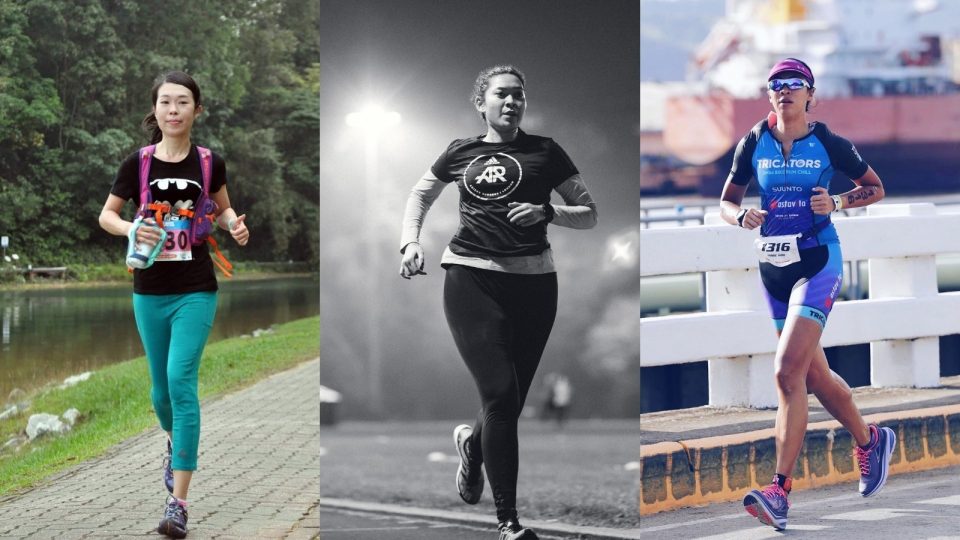

Women’s running is more popular around the world than ever before. It is truly inspiring to see what they have achieved in the running scene. They have empowered and taught us to be strong, resilient, and persevering, and to have the courage to cross the finish line like a boss. In summary, women really do run the world (no pun intended).
We spoke to three elite women runners as they talked about how they became female athletes and what motivates them. Their reasons for running will undoubtedly inspire you to join them at the starting line of a marathon.
1. Jamie Goh
Bio: Singaporean, 32-years-old, Swim Coach/ Private Tutor

As a teenager, Jamie was on her school’s Track and Field and Cross-Country running teams. She was passionate about sports from a young age. Fast forward to today, and she actively takes part in marathons, ultra-marathons, and triathlons.
RS: What inspired you to be a runner?
Jamie: My interest in running started when I joined my school’s Track and Field team out of curiosity and found that I really liked it. As I grew older, I got intrigued by marathons and made it a goal to take part and complete one. So, I ultimately signed up for my first marathon, crossed the finish line, and wanted more!
I loved feeling all the emotions I felt during the race, both good and bad. Nothing can compare to the euphoria when you cross the finish line, knowing that it’s your achievement.
RS: How do you push yourself to run faster in a race?
Jamie: “Gotta meet the cut-off time!” haha.
Honestly, it’s usually the thought of being able to get myself a good shower, some ice cream, and food after the race! Also, I look forward to meeting up with friends at the finish line and sharing our race experiences.
RS: Can you share your marathon training and how you train for a marathon?
Jamie: I aim to run 2-3 times a week (or more if my schedule allows), with one of the runs being at least 10km. I’ll also incorporate strength training 2-3 times a week. On other days, I do some indoor/outdoor cycling or swimming as part of cross-training.
RS: What encouraged you to keep running as a woman athlete?
Jamie: The sense of satisfaction and the high of crossing every finish line. The camaraderie and friendships formed over a common interest in sports and running. It is also always uplifting to see more women being active and taking part in sports and races. Besides, why let guys have all the fun when we women can have it too?
RS: From your experience, what advice would you give other women looking to train at a high level?
Jamie: Don’t be afraid of new challenges, but set realistic goals towards them. Map out a plan that you can accomplish, and don’t be embarrassed about having to take small steps at a time. You don’t have to rush into taking huge leaps; every little step will get you to your end goal.
You can follow Jamie on Instagram: @purpledelic
2. Nuraini Ariel Malik
Bio: Singaporean, 32-years-old, Associate Director (Strategic Insights)
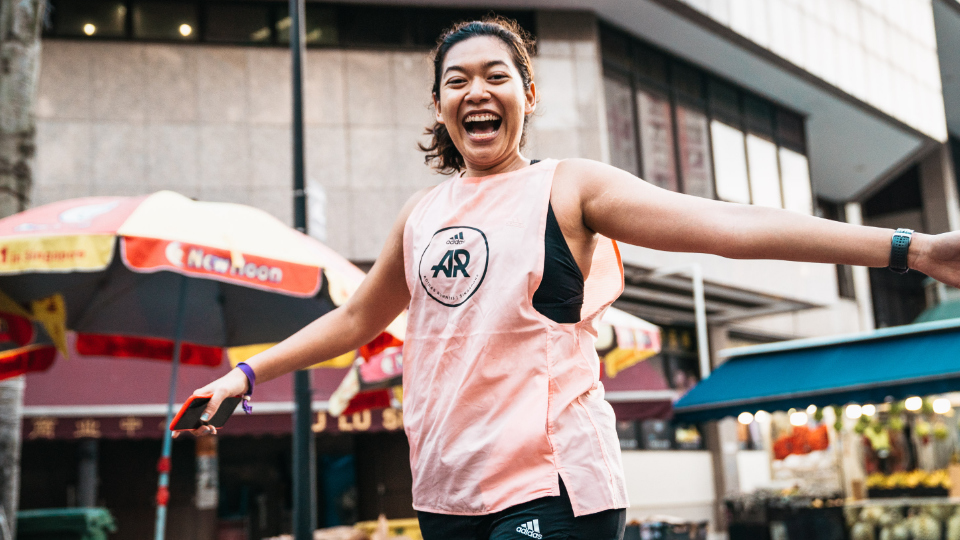
When Ariel was younger, she wasn’t into running. She had asthma, and she disliked the discomfort it caused. In 2013, that started to change. She took up running as a way to train to climb Mt. Kinabalu. After the climb was over, she realised that she missed the endorphins that running gave her, so she signed up for her first 10k. That race got her hooked, and she worked her way up to her first marathon in December 2015.
Since then, she has been completing a marathon every year and finished her fifth in 2019. Now, even with no races on the horizon, she runs because she loves the feeling of the wind in her hair and keeps on pounding the pavement.
RS: What inspired you to be a runner?
Ariel: Honestly, my initial feelings towards running were purely functional. I signed up for a Mt. Kinabalu climb, and I needed the cardio training. Since then, my sentiments have changed, depending on what comes out of my introspection and goal-setting for the year.
A marathon is unpredictable, and the physical and mental challenge is a humbling one. Other times, it’s been about motivating others to attain their goals when I was a pacer at races. In the past year, it’s been more about rediscovering the joy of running—free from pressures and expectations—and learning more about myself through the journey.
RS: How do you push yourself to run faster in a race?
Ariel: They say the hard part of marathon racing is the training: 16 weeks of commitment, discipline, setbacks, trade-offs, and an injury or two. Then, when it comes to race day, it’s about trusting your training and yourself.
I think of the journey I’ve been on, the highs and the lows, and that pushes me. Other things, like knowing you’re going to see a friend at a certain kilometer mark or at the finish line, or thinking of that pint of beer at the end after abstaining for a month, help too!
RS: Can you share your marathon training and how you train for a marathon?
Ariel: I’ve never had the same training every year! Our bodies are always changing, and I’m still learning and experimenting with what works for me during any given marathon season. When I started out, I didn’t have a training plan, and there was a lot of ‘winging it’ or ‘don’t think, just run’—I really don’t recommend that!
I invested in a proper marathon training programme with a coach, and that helped tremendously in equipping me with a firm foundation. My programme has changed each year since then, depending on my goals and other things going on in my life during the training season. Each season feels like a new journey of testing out and discovering what works for me—from gear to nutrition to the frequency of training. However, these key components remain:
- Rest days: These are still part of training.
- Running: A mix of easy runs, speed work, and long runs.
- Cross-training: Strength and conditioning work.
- Nutrition: Food is your fuel (physical, mental, and emotional).
RS: What encouraged you to keep running as a woman athlete?
Ariel: Knowing that we can all do it as long as we put our minds to it. Running is a celebration of what our bodies and minds are capable of. Seeing diversity in the sport—body shapes/sizes, running backgrounds, life experiences, struggles—reinforces that. Women who redefine what strength looks like, especially those within my running community, inspire me.
RS: From your experience, what advice would you give other women looking to train at a high level?
Ariel: Start off each ‘season’ with some self-reflection and goal setting—whether it’s a faster time, to be injury-free, to finish strong, to pace a friend, or even just to have fun. And when the going gets tough, remind yourself why you started in the first place.
When it comes to a training programme, it’s important to have flexibility and adaptability. We lead busy lives, and we’re not machines, so we’re going to miss a couple of sessions here and there or not hit the target mileage or pace. Be kind to yourself; tomorrow is a new day.
You can follow Ariel on Instagram: @nuraini.ariel
3. Faith Fong
Bio: Singaporean, 39-years-old, Freelance
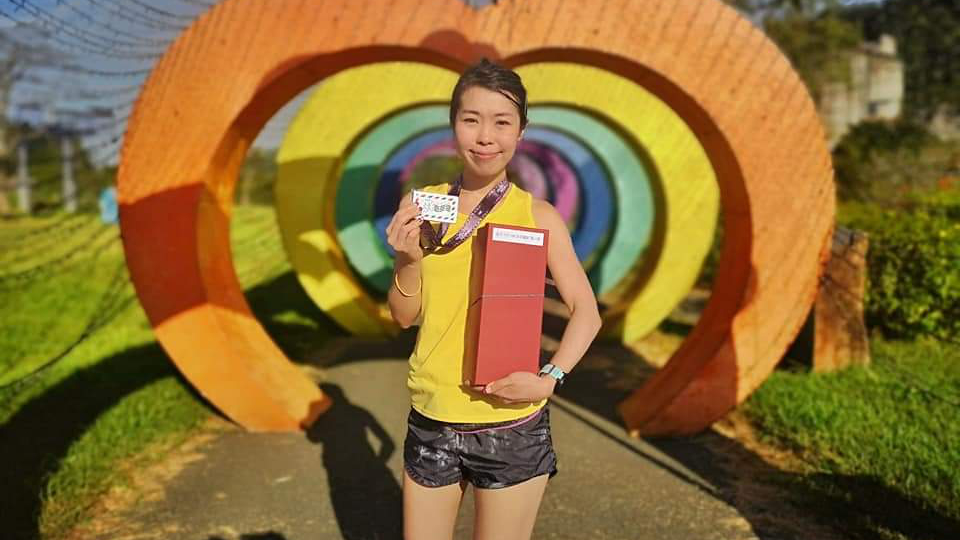
Faith started her running journey in 2012. She started with the 10km distance, and the Sundown 2012 Run was her first race. The following year, she began training for longer distances and tried various trail races and ultra-races to gain more experience.
RS: What inspired you to be a runner?
Faith: Food! I love to eat! Before my running journey, I took slimming pills daily. Until one day, I decided to adopt a healthy lifestyle and found running as my passion.
RS: How do you push yourself to run faster in a race?
Faith: It is all in the mind! You must teach yourself during training that you can go faster. Tell your mind that increasing your effort won’t kill you. And when it comes to a race, you will nail it!
RS: Can you share your marathon training and how you train for a marathon?
Faith: Marathon training can vary depending on your current fitness level, schedule, past injuries, medical conditions, etc. For me, I familiarised myself with 5Ks, 10Ks, and half-marathons as a way to physically and mentally prepare for longer distances.
Everyone is different. If you have a strong base, 16 weeks is more than enough. For me, I typically run three to four times a week, increasing my mileage as I get nearer to race day. On the other days, I do cross-training and, most importantly, rest my legs, allowing them to fully recover.
RS: What encouraged you to keep running as a woman athlete?
Faith: My love for nature! I love to admire this beautiful earth, especially in the woods where transport can’t bring us.
RS: From your experience, what advice would you give other women looking to train at a high level?
Faith: Adopt a suitable plan for yourself. Give yourself some flexibility to adjust as and when required to suit your body’s needs, and pay attention to how it responds.
You can follow Faith on Instagram: @angelfaithfaith
Do you feel empowered by our three elite women runners and want to complete a marathon?
